September Managerial Duels
For in much wisdom is much grief…
On Saturday, I took part in a managerial duel. It was my first time, so I prepared rather thoroughly: I studied the rules, watched several duels from previous years, and read about methods for analysing conflict situations and developing tactics for each duel.
I drew several conclusions:
- Some roles in a duel offer strong positions, while others are weak.
- The player who takes the initiative—attacking rather than defending—wins more often.
- The best way to attack is to introduce “new facts”: circumstances that are not included in the original conflict scenario but do not contradict it either.
- It is disadvantageous to play the role of the person who initiated the conflict. In that case, you need a prepared new fact that turns the situation completely on its head.
I prepared thoroughly for my own duel: I worked through every combination of roles and came up with more than twenty new facts for different situations. I decided to play assertively and seize the initiative whenever possible, forcing my opponent to follow my scenario. My second was the highly experienced Airat Khusnutdinov; he reviewed my analysis and agreed with it.
The random draw went my way: in the first round, I assigned the roles and made the opening move. Naturally, I chose the stronger position. I began the round very assertively, introduced many of my prepared new facts, backed my opponent into a corner and offered him a carefully planned win-win solution, which he accepted.
In the second round, my opponent assigned the roles. His choice was rather unexpected, but I was ready for it too. At the start of the round, he followed the most predictable scenario. When the moment was right, I introduced an unconventional new fact that took him aback and forced him to pause for a consultation with his second. After the break, he introduced an original new fact of his own that almost neutralised mine. We sparred within this new set of facts for a little longer and eventually brought the round to a mutually acceptable compromise.
I was pleased because I had followed the game plan Airat and I had developed to the letter.
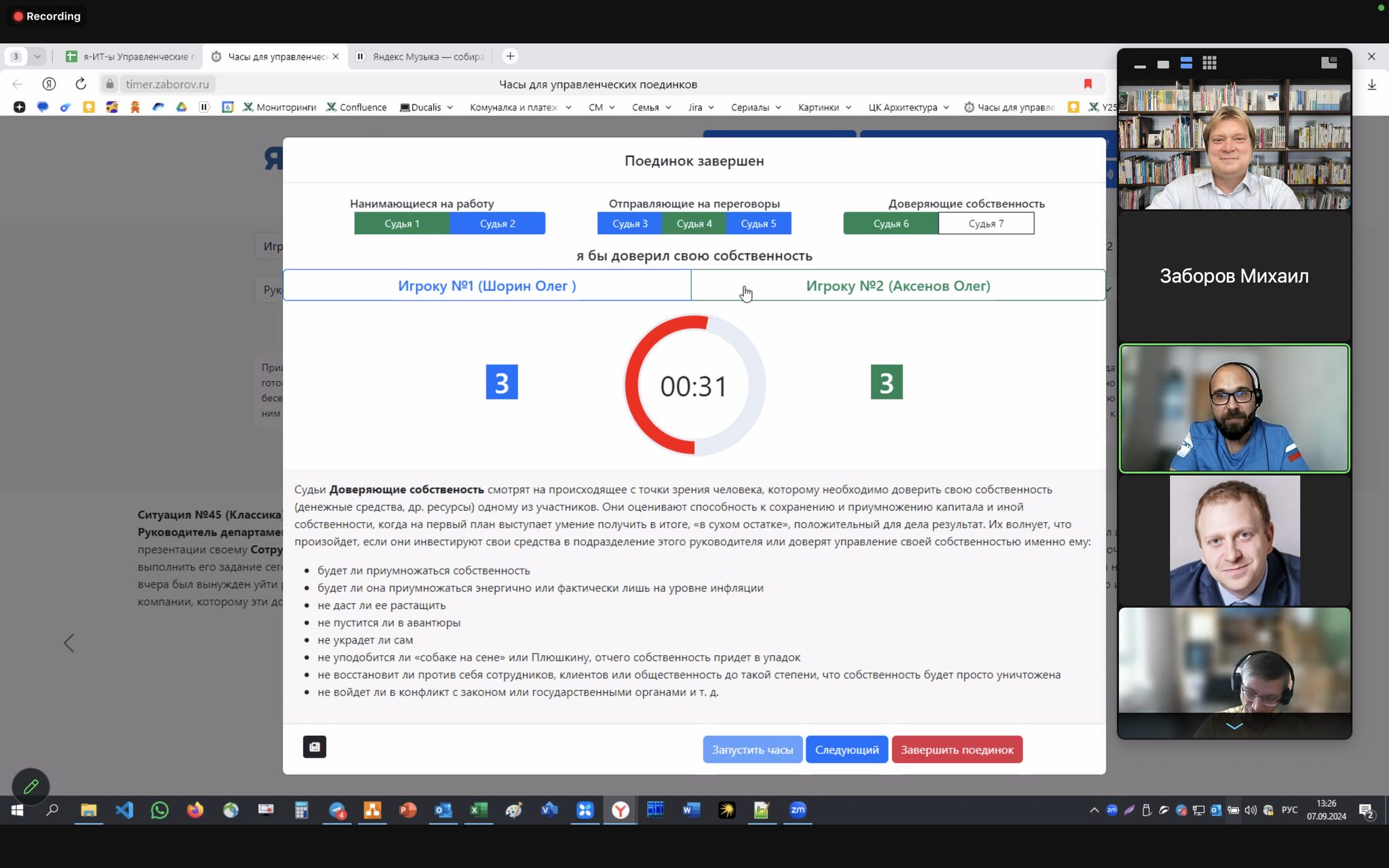
After the duel, the judges sent their votes to the chief referee and then gave their feedback in turn. They all said that choosing a winner had been very difficult because the players’ styles were diametrically opposed. After six judges had spoken, the score was tied at 3–3. Everything came down to the final judge’s vote, and he kept his decision secret until the very end (see photo).
This time, my opponent won. The main argument from the judges who voted for him was that he had outplayed me in the first round: he secured a win-win solution while doing practically nothing. I, meanwhile, had made things so easy for myself with my new facts that my approach was completely out of proportion to the scale of the problem.
So, this time I ended up beating myself 🤦♂️