The Gutenberg Bible
The Book of Books.
In 1439, the German craftsman Johannes Gutenberg came up with the idea of using movable type, which would later form the basis of the printing press. With the invention of the printing press, books stopped being one-off, expensive objects available only to wealthy people and institutions. Books began to be mass-produced, and printing houses, catalogues of printed works and exhibitions appeared. The printing press revolutionised the spread of knowledge.
After gaining experience in printing, Gutenberg produced an edition of beautifully made Bibles in the early 1450s. Although this was not technically the first edition produced using a printing press, it is considered the most valuable printed book.
Gutenberg is thought to have printed 180 copies: 30 on vellum and 150 on Italian watermarked paper.
Pre-revolutionary Russia had only one copy of the Gutenberg Bible, held by the National Library of Russia in St Petersburg. But it was sold in 1931. One of the librarians, understanding the book’s significance, tore out a page shortly before the Bible was handed over. That page remains at the National Library of Russia to this day, while the Bible itself is now at the Bodmer Library in Switzerland. For reference, a single leaf from a Gutenberg Bible was offered for sale for $100,000 in 2012.
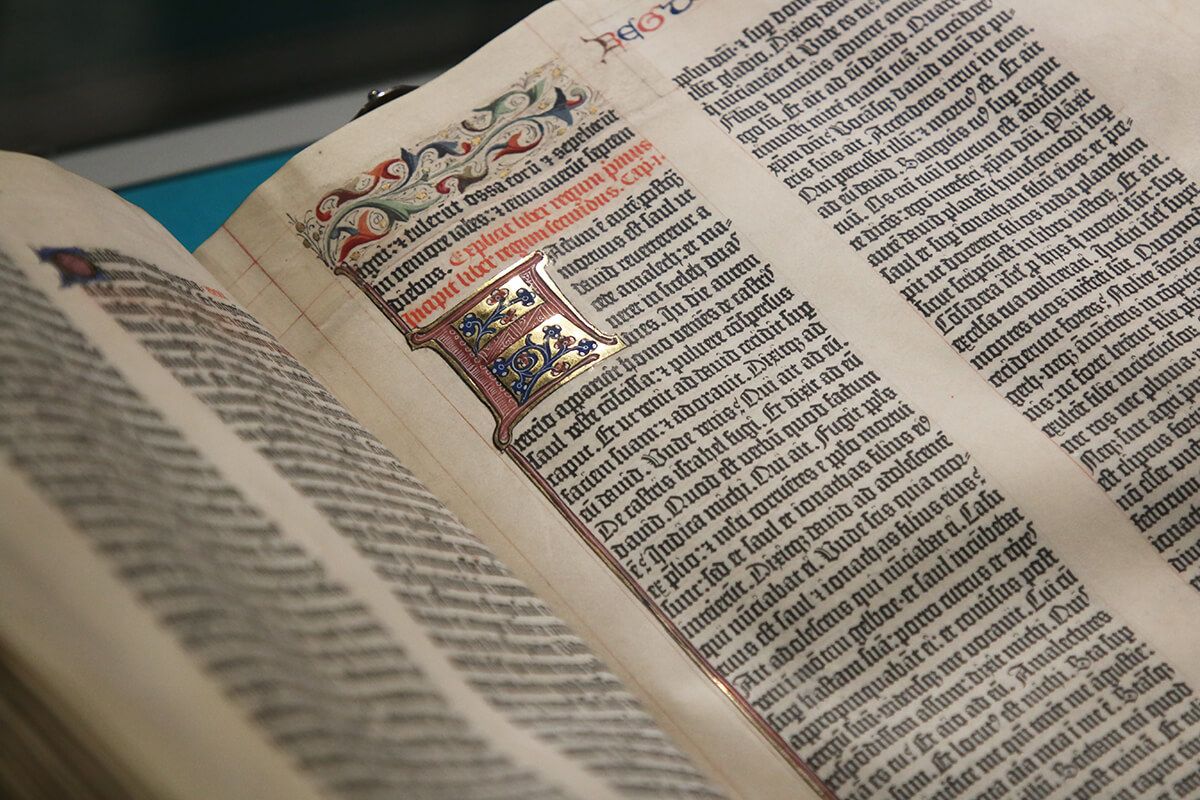
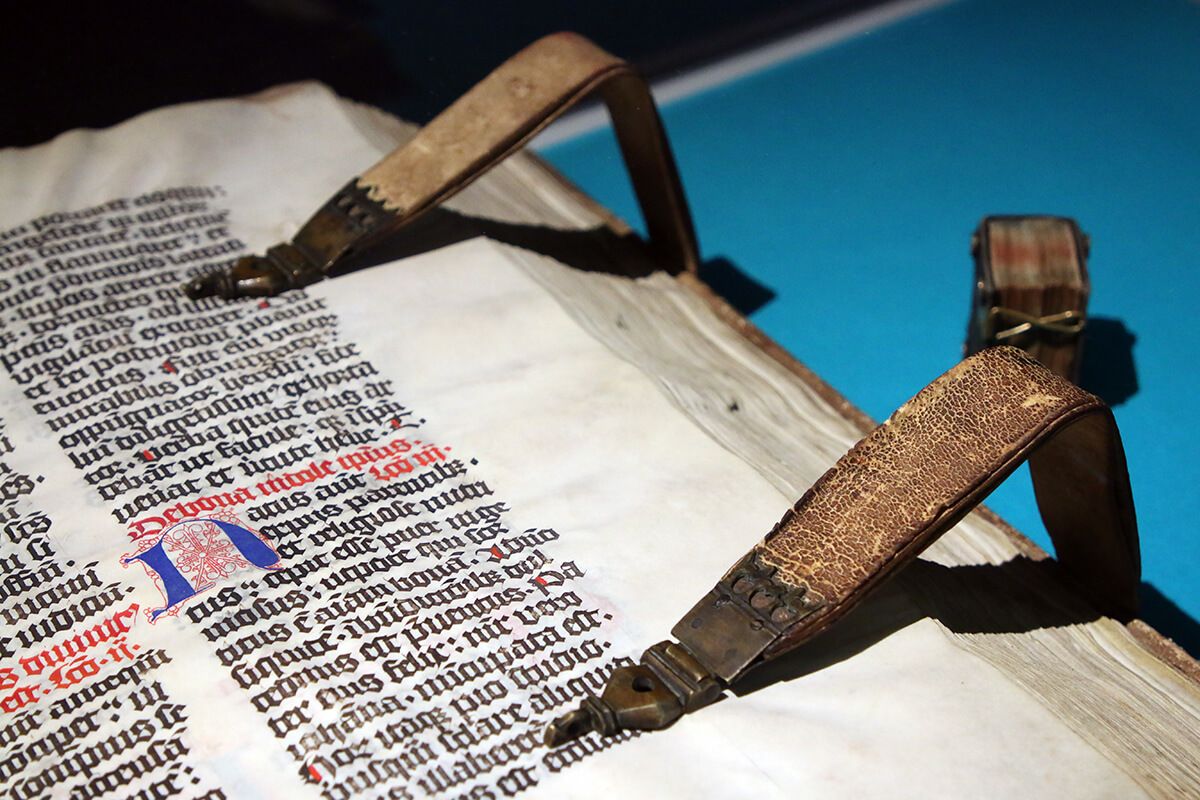
In 1945, two copies were brought from Leipzig to the Soviet Union as war trophies. One, printed on vellum, is held by the Russian State Library, also known as the Lenin Library. One of its pages is a facsimile made in 1877, so the copy is considered incomplete. The other, printed on paper, is a complete copy held by Moscow State University. Russia therefore now has two copies – one complete copy on paper and one incomplete copy on vellum – as well as a single paper leaf.
At present, 49 copies of the Gutenberg Bible are known to exist, only 12 of them printed on vellum. Complete vellum copies are rarer still – there are just four, in Paris, London, Göttingen and Washington.
The institutions with the largest holdings of Gutenberg Bibles are:
- The Morgan Library & Museum (New York, USA) – three copies: an incomplete vellum copy, and a complete and an incomplete copy on paper;
- Bibliothèque nationale de France (Paris, France) – two copies: a complete vellum copy and an incomplete copy on paper;
- British Museum (London, UK) – two complete copies, one on vellum and one on paper;
- Vatican Apostolic Library (Vatican City) – two incomplete copies, one on vellum and one on paper. I have seen one of them.
Each of the remaining 40 copies is held by a different institution.
From 16 April to 16 June 2019, the Russian State Library held an exhibition devoted to the Gutenberg Bible. Visitors could see the Library’s own copy there.
Naturally, I went.
In the photos: the Russian State Library’s copy of the Gutenberg Bible.