Endless Recopying
In a recent article, I reflected on compatibility between storage media, data formats, operating systems, and editing software.
Beyond all that, storage media also deteriorate physically. Experience shows that after five to ten years, natural degradation can demagnetise and deform floppy disks and produce bad sectors. The situation is similar with CDs, DVDs, and Blu-ray discs, while HDDs and SSDs do not last forever either.
When I returned to the National Library of Russia after visiting the Vatican Library, I realised that the digital data held there would most likely be irretrievably lost within a few years. To prevent that, I established a process of endlessly recopying the data.
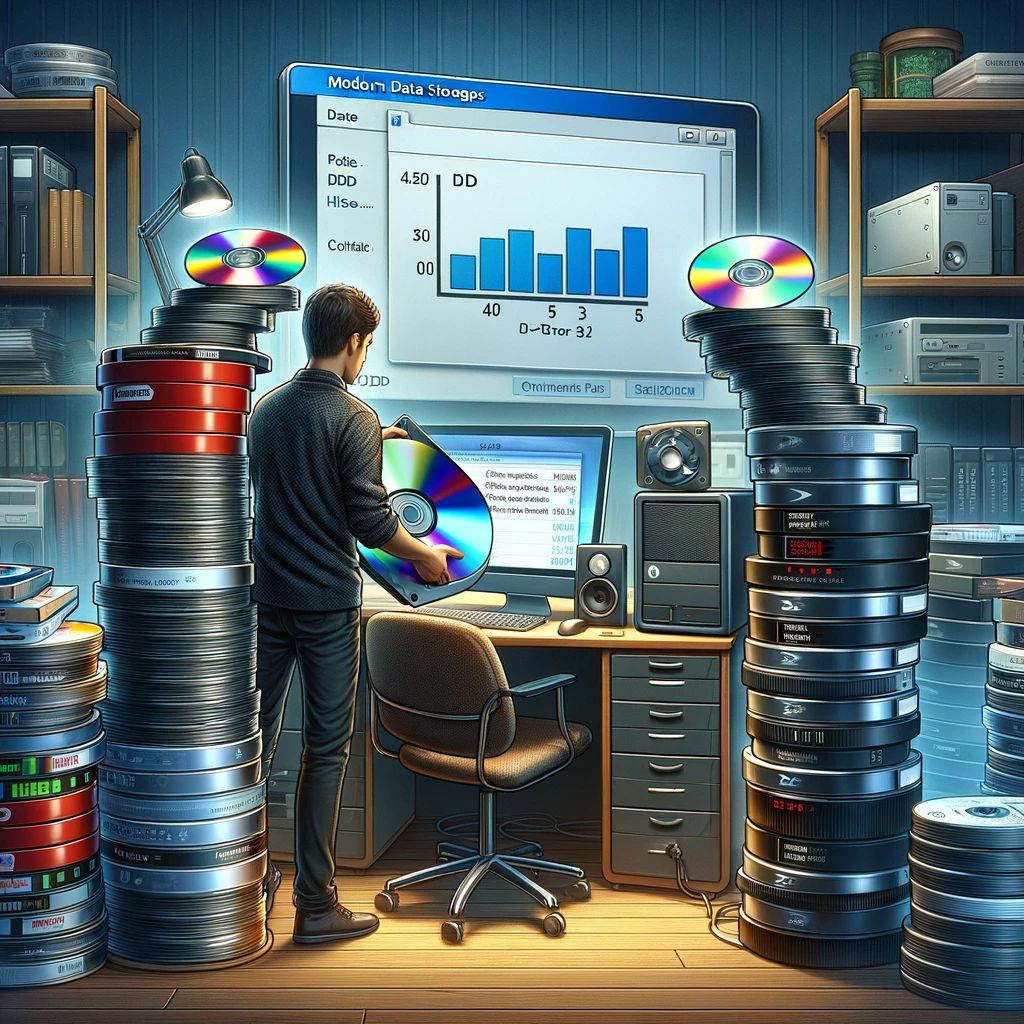
The National Library of Russia kept a register of disks and other media acquired at different times. After sorting the list by date, we began copying the oldest files to modern storage. At some point, we realised the process would never end: by the time we had copied all the data, the storage system would no longer be modern, and we would have to copy everything from it somewhere else.
This created a process at the National Library of Russia in which the oldest data is continually recopied to whatever storage medium is considered current at the time. The data is constantly migrated, ensuring that it remains readable regardless of media compatibility or the technology in use.
Clearly, this is not the most efficient way to preserve information. So, while serving as director of the Library for Natural Sciences of the Russian Academy of Sciences, I managed to push a new research project through the Ministry of Science and Higher Education and the Russian Academy of Sciences. Its purpose is to develop, test, and implement an information-processing pipeline that ensures accumulated knowledge remains usable regardless of the evolution of storage hardware and software or the lifespan of storage media.
The research project is titled “Improving Methods for the Long-Term Preservation of Scientific Information as a Foundation for Knowledge in the Natural Sciences” and is scheduled to run from 2024 to 2028.
I will be following my colleagues’ publications on the subject!